A Reflection & An Invitation: Rejoice in the Beautiful Game
In the Denver Area? Join us this Saturday, June 13th in Lafayette to watch Haiti take on Scotland in the World Cup. Click here to learn more about the watch party and our girls’ soccer league.
Dear friends,
I'm always impressed when people rattle off the dates and years of their life with certainty. My dad will say, “Oh yeah, the summer of '77, I was in the city," or “I left that job at the paper in ‘85.” My mind doesn't work that way generally speaking, but one extreme exception is the year 2010; a fork in the road for me, a year where the dates, events, and downstream consequences are etched with clarity.
I first traveled to Haiti after the earthquake of January 12, 2010. I intended to stay for two months before returning to New York for graduate school, but by the time those months had passed I'd extended to stay another year, seeing clearly that in that moment, in that place, I was receiving an education like no other.
By that first summer, I was fully enmeshed in the work of the St. Luke Foundation, an extraordinary organization founded by Father Rick Frechette, and led by a team of remarkable Haitian women and men. Haiti in 2010 was a window into the best we’re capable of, and also a clear view of the worst consequences of how our world is organized — collecting and burying bodies, delivering food to tent camps, constructing field hospitals, and founding new schools and summer programs. It was nonstop work, it was important, and I felt fortunate to be there playing my small part. And amidst the pain, the suffering, the loss, the struggle, there was so much joy, camaraderie, and laughter. This too was a revelation, how these things all lived together.
The 2010 World Cup was an intense manifestation of this improbable joy. In tent cities, at small roadside restaurant stands, through rhythmic Kreyol radio play-by-play, in the official World Cup anthem blaring from every vehicle, the country was rapt, present, fervently invested. Haiti didn’t qualify for that World Cup, and so that summer Haiti had split, the way it does, into the faithful of Brazil and the faithful of Argentina. Their flags hung everywhere: over storefronts, across alleys, from battered pickup trucks, above the blue tarps of the sprawling housing camps. A place the whole world had just watched fall to its knees had strung up its colors. It was a joy that didn't ask anyone's permission, that didn't require conversations or decisions. It was a joy that didn't diminish the struggle, but lived beside it.
In the years since, soccer has been an important thread in my life. I met and eventually adopted my own sons, who are originally from Port au Prince, as they played on dusty urban fields. Later I watched them develop on the manicured grasses of clubs, high schools, and universities here in the U.S.
In Petit Trou, I continue to watch with a bittersweet appreciation. The late-afternoon pickup games as the sun goes down, the girls’ league we support, the kids playing barefoot in the central square, the cheers coming from the small restaurants that charge 50 cents to watch European league games. Soccer is the world’s game, and it is very much Haiti’s game.
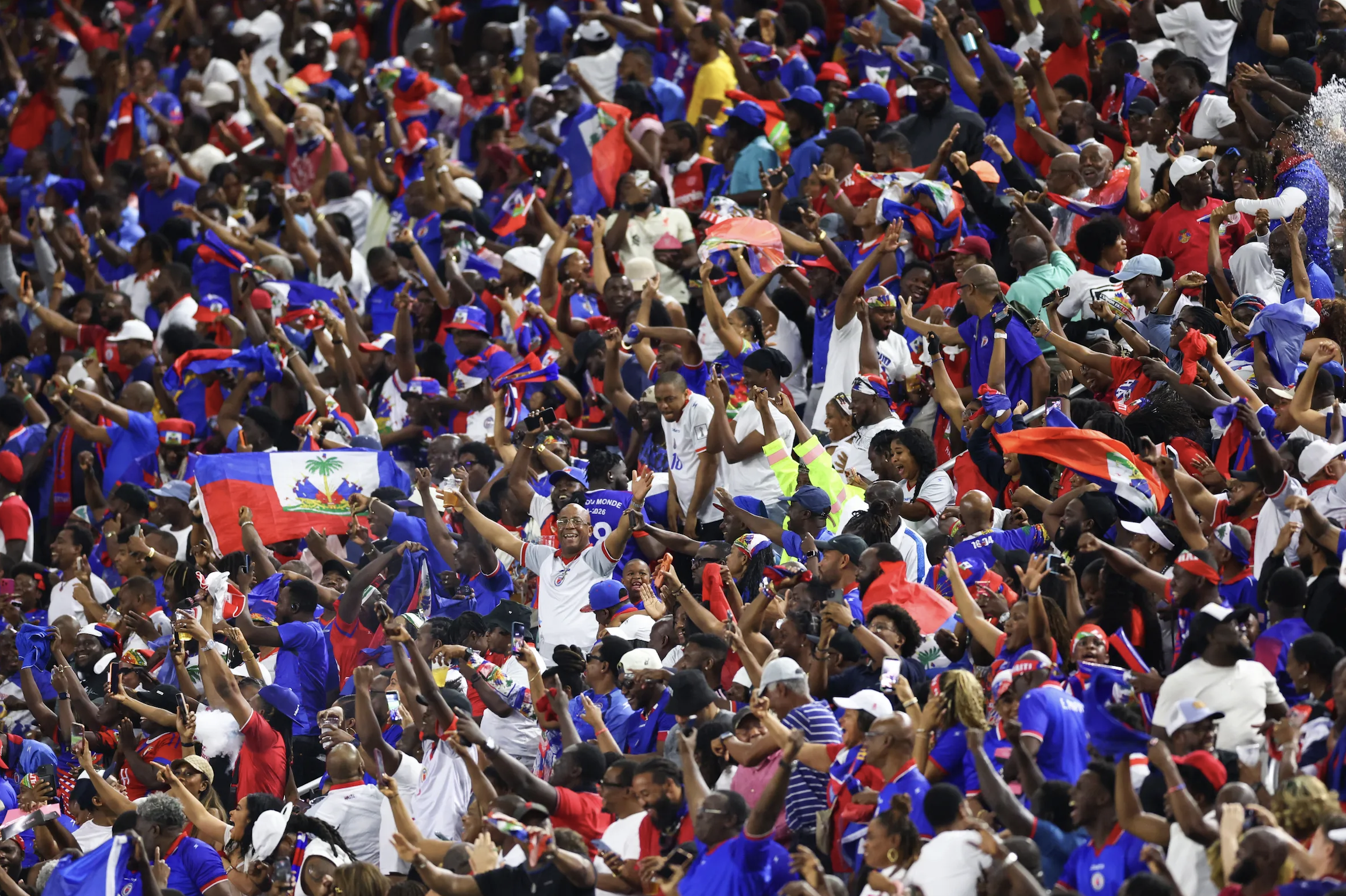
And then, this past November, something extraordinary happened. On November 18, in a "home" match played 500 miles from home due to the violence that made hosting impossible, at the end of an up and down qualifying campaign that I followed intently with my sons, Haiti beat Nicaragua 2–0 and clinched a place at the 2026 World Cup. Fifty-one years of waiting, ended by a team that can't set foot on its home field. And the date! On November 18, two hundred and twenty-two years earlier, Haiti's army defeated the French forces at the Battle of Vertières and made Haiti the first free Black republic. Haitian people know their history, and this was not lost on the thousands who celebrated in the streets that night, defying the gangs and claiming the avenues as their own.
The World Cup, and FIFA, its governing body, are imperfect. (A gross understatement, left as such for the sake of brevity.) And for the U.S. to be one of the hosts in this current climate is complex. At the very hour Haitian and Haitian American families gather to cheer, many are watching for news updates or looking over their shoulders, worried about a pending Supreme Court decision that will decide the fate of hundreds of thousands who came here legally and may in a matter of seconds, become “illegal.”
You can view the World Cup through different lenses in different moments — I do it myself. But the reality is that when Haiti starts their first match on the 13th vs. Scotland, the country will be rapt with hope, and wrapped in joy and wonder at what might happen over the next month. The “what if” is the joy, and what I’ve realized — thanks in part to my time in Haiti — is that joy is a powerful and necessary fuel.
There are many stories I could tell about how Haiti taught me this lesson, but the one that occurs to me isn’t about soccer. It's about cholera.
In the fall of 2010, the team at St. Luke was knee-deep in the fight against cholera. We would leave each night at 6 p.m., working our normal days and then meeting in front of the hospital for a night shift aimed at helping rural communities facing the first waves of the deadly cholera epidemic. We’d take a 20 foot long flatbed truck, loaded three feet high with supplies. We’d sit on boxes of IV fluids, oral rehydration salts, Gatorade, IV catheter needles of various sizes, Clorox, water treatment tabs, and gloves, our destination small villages with no hospitals or clinics, experiencing deadly outbreaks. On the road we often stopped and shared information, soap, water purifying tablets, and hand sanitizer. All shoes, clothes, and vehicles were coated in Clorox solution to ensure there could be no transmission upon our return.
One night, on the way home, I leaned back on the edge of the truck, chatting with Father Rick in the early hours of the morning. The team sang a Haitian spiritual as we bumped along to the laughter and harmony.
"It's a little strange, isn't it? How often we laugh, how beautiful the moon looks, how perfect the soundtrack is. When you think of the tragedy of what we're doing each night. Laughing and enjoying the beautiful views feels a bit odd somehow."
I shared this absent-mindedly, almost to myself. I looked up to see Father Rick looking at me with compassion.
"It's the only way this works," he replied. "It has to be this way. This is what we fight for — we fight to give more of this; to give more chances at this, more chances at life, friendship, the moon, the trees, breath, harmony." He waved his hand in a wide circle. "If we can't see all of this for the beauty that it is, if we can't breathe it in deep, the fight sure will get hard."
The joy lives with the pain, and the joy fuels the work. The fleeting, imperfect, and complex joy is what we’re all fighting for.
Watch Haiti play this World Cup. Listen to the fans cheer and sing. Drag a chair into the street and believe alongside an entire country, because their joy is our joy, and joy, even imperfect or bittersweet inside a complex reality, is the cleanest fuel we have. If we can't take a moment to enjoy it together, the fight sure will get hard.
Thank you as always,
Wynn